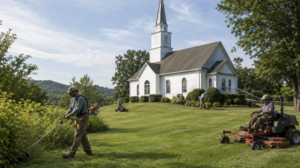
Church properties often include far more than a sanctuary and a parking lot. Across Lewisburg and the surrounding Greenbrier Valley, churches may care for lawns, wooded edges, cemeteries, fellowship areas, walking paths, open fields, roadside frontage, drainage areas, and undeveloped acreage. Those grounds are part of the church’s identity and often support worship, community gatherings, outreach programs, weddings, funerals, seasonal events, and everyday fellowship.
Lewisburg’s setting makes thoughtful land care especially important. The community sits among the Allegheny Mountains and is surrounded by rolling farmland, wooded areas, and a landscape known for its natural beauty. The City of Lewisburg’s history describes a community where historic buildings, churches, country roads, farmland, ponds, and mountain scenery remain closely connected. For churches that own substantial property, maintaining that landscape can require much more than routine mowing.
Professional Large Acreage Vegetation Management Lewisburg WV can help churches maintain larger properties efficiently while improving accessibility, appearance, safety, and the long-term usability of their land. 🌿
Church Grounds Are an Important Part of the Property
The appearance of church property makes an impression long before someone walks through the sanctuary doors. Visitors arriving for worship, families attending weddings or funerals, community members coming to events, and people simply passing along the road all see the grounds surrounding the building.
Lewisburg has a particularly strong connection between its churches and its historic landscape. Wikipedia’s overview of Lewisburg, West Virginia places the city in Greenbrier County and provides background on the community’s geography and development. The town’s distinctive setting is one reason maintaining church acreage can have an impact beyond the boundaries of an individual congregation.
Well-maintained grounds can make large church properties feel inviting without making them look overly manicured. Open fields can remain usable. Wooded borders can be kept from overtaking developed portions of the property. Road frontage can stay visible, and areas surrounding signs, entrances, parking lots, and gathering spaces can remain orderly.
When acreage is left unmanaged for long periods, however, brush, saplings, vines, weeds, and rapidly growing vegetation can gradually take over.
Large Properties Require a Different Approach Than Ordinary Lawn Care
A church with several acres of open or partially wooded land faces very different maintenance needs from a property with a small landscaped lawn.
Standard mowing equipment may work well immediately around a sanctuary, fellowship hall, or office, but it may not be practical for rough fields, steep sections, wooded edges, drainage corridors, overgrown fence lines, or areas filled with dense brush.
Large acreage vegetation management focuses on controlling that heavier growth while taking the character and intended use of the property into account. The goal is not necessarily to turn every acre into finished turf. Instead, certain areas can be kept open while natural sections remain intact and unwanted growth is brought under control.
This approach can be especially useful in Greenbrier County, which covers more than 1,000 square miles and includes agricultural land, timber resources, mountains, and outdoor recreation areas, according to the official Greenbrier County website.
For churches with similar rural or semi-rural surroundings, managing vegetation strategically can be considerably more practical than attempting to maintain every part of the property like a conventional lawn.
Vegetation Management Helps Protect Historic Church Settings
Church history runs deep in Lewisburg.
One of the community’s best-known landmarks is Old Stone Presbyterian Church. According to the church’s own history of Old Stone Presbyterian Church, the congregation was organized in 1783 and its current sanctuary was completed in 1796 using native limestone. The property has remained part of Lewisburg’s religious and community landscape for generations.
The West Virginia Encyclopedia’s history of Old Stone Presbyterian Church also documents the church’s long connection to the region and its place in West Virginia history.
Historic church properties often include mature trees, old cemeteries, stonework, monuments, walls, pathways, and landscapes that deserve careful treatment. Heavy vegetation growing around these areas can hide important features, make access difficult, and gradually change the appearance of the property.
Thoughtful vegetation management allows churches to control unwanted growth without unnecessarily stripping the land of the trees and natural features that give the property its character.
For congregations stewarding land that has been part of the community for decades or even centuries, maintaining the grounds becomes another way of preserving local heritage. ⛪
Managing Overgrowth Can Improve Access Around Church Property
Church acreage is often used in ways that change throughout the year. An open area may host an Easter gathering in spring, outdoor fellowship in summer, a fall festival, or a Christmas event later in the year. Other sections may provide overflow parking, access to a cemetery, space for youth activities, or simply room for congregation members to enjoy the property.
Uncontrolled vegetation can gradually reduce the amount of usable land available for those activities.
Brush creeping toward parking areas can narrow usable space. Tall weeds can cover paths. Saplings can establish themselves along field edges. Vegetation can obstruct access to cemetery sections or maintenance roads. Growth near entrances can interfere with sight lines for drivers entering or leaving church property.
Clearing and maintaining selected areas helps churches reclaim land without requiring development or construction.
That flexibility is especially valuable when community activities extend beyond weekly services. The Greenbrier Valley events calendar reflects the wide variety of cultural, seasonal, family, and community activities taking place throughout Lewisburg and the surrounding area. Churches are part of that larger community fabric and frequently provide their own gatherings, ministries, and outreach opportunities.
Church Cemeteries Need Reliable Access and Thoughtful Maintenance
Many older churches throughout West Virginia have cemeteries located on or near their property. These spaces require special care because families need reliable access while grave markers, memorials, trees, and surrounding land must be respected.
Vegetation can become difficult to manage when cemetery property borders woods or open acreage. Vines, brush, saplings, and tall growth may move steadily toward maintained areas. Older sections that receive less foot traffic can become particularly vulnerable to overgrowth.
Large acreage management can help establish a manageable boundary between cemetery grounds and surrounding natural areas. Access routes can also be kept open for family members, maintenance crews, funeral services, and future burials.
This type of work should complement detailed cemetery maintenance rather than replace it. The broader surrounding vegetation can be controlled while more delicate areas around markers and graves receive the careful attention they require.
Maintained Acreage Can Support Outdoor Ministry and Fellowship
Church land can become an asset for ministry when it is accessible.
An open field can provide space for youth activities, church picnics, vacation Bible school events, outdoor worship, community meals, seasonal celebrations, and fellowship gatherings. Trails or quieter areas of a larger property can provide peaceful settings for prayer, reflection, or small-group activities.
Lewisburg already has a strong tradition of gathering outdoors. The Greenbrier Valley Convention and Visitors Bureau highlights community events such as the Ivy Terrace Concert Series at Carnegie Hall, where residents gather outside for family-friendly entertainment. The popularity of outdoor spaces throughout the area demonstrates how valuable usable grounds can be to community life.
Churches do not have to develop every acre in order to benefit from their land. Simply clearing excessive vegetation, controlling brush, and establishing usable open areas may create opportunities that were previously unavailable.
A neglected portion of property can become a functional extension of the church campus.
Vegetation Control Can Make Routine Maintenance More Manageable
Heavy overgrowth rarely becomes easier or less expensive when ignored.
A few young saplings can eventually become established trees. A small patch of brush can expand along a fence line. Vines can climb into desirable trees. Tall vegetation can obscure fallen limbs, holes, rocks, discarded materials, or drainage problems.
Managing those areas before vegetation becomes extremely dense can simplify future property care.
Once an overgrown area has been brought back under control, a church can develop a realistic maintenance schedule based on how the land is actually used. High-visibility areas may require frequent attention, while fields and perimeter areas may only need periodic management.
This can be especially valuable for churches whose maintenance responsibilities are shared among staff members, volunteers, trustees, property committees, or congregation members.
Instead of constantly reacting to overgrowth, leadership can establish a more predictable approach to caring for the property.
Clearer Road Frontage Helps Churches Remain Visible
Churches located on larger parcels may have long stretches of road frontage. Overgrown vegetation along those areas can gradually hide signs, driveway entrances, buildings, fences, and other identifying features.
Maintaining appropriate visibility serves both practical and aesthetic purposes.
Drivers approaching the property can more easily identify entrances. Visitors unfamiliar with the church can locate the campus. Church signs and directional markers remain visible. Property edges look cared for rather than abandoned.
Greenbrier County’s official community resources even identify churches as important local facilities. The county’s election and community location information lists churches among locations used by residents for civic purposes, demonstrating the broader role church properties often play within local communities.
Keeping those properties accessible and recognizable supports that community presence.
Vegetation Management Can Preserve Natural Beauty Without Clearing Everything
Good land management is not the same as removing every tree, shrub, or natural area from church property.
Lewisburg’s landscape is part of what makes the area distinctive. Mature trees, woodland borders, rolling fields, and mountain views contribute to the character of the Greenbrier Valley.
Strategic vegetation management works best when it separates desirable natural growth from vegetation that is interfering with the property.
A church may want to preserve a wooded boundary while controlling brush along its edge. A field may remain largely natural but require periodic cutting to stop woody vegetation from taking over. Mature trees may remain while undesirable saplings and vines are controlled.
This creates a balance between stewardship and usability.
The result can be property that still looks like it belongs in the West Virginia landscape while remaining functional for the congregation.
A Long-Term Plan Helps Churches Be Better Stewards of Their Land
Church leaders are often responsible for making decisions that will affect the congregation long after their own terms of service have ended. Buildings, roofs, parking areas, equipment, cemeteries, and grounds all become part of that stewardship responsibility.
Large acreage deserves the same long-term thinking.
Rather than waiting until vegetation has become a major problem, churches can identify which sections of the property should remain open, which should stay natural, which require regular access, and which areas need periodic vegetation control.
That plan can change as the church changes.
A congregation may eventually need additional parking. A cemetery may expand. A youth ministry may begin using an outdoor area. A new fellowship pavilion may be considered. Property that has been kept accessible provides more options when future needs arise.
Land that has disappeared beneath years of unmanaged growth can be much harder to put back into service.
Conclusion
Church properties in Lewisburg are more than buildings surrounded by grass. They can include generations of history, wooded land, cemeteries, gathering areas, fields, road frontage, and natural spaces that connect congregations with the wider Greenbrier Valley.
Managing that acreage thoughtfully can help churches maintain attractive entrances, preserve access, protect historic surroundings, support outdoor fellowship, control encroaching vegetation, and make better use of land they already own.
Lewisburg’s churches have long been part of the identity of the community. From historic sanctuaries to active congregations serving families today, their properties remain visible reminders of faith, fellowship, and local history.
Responsible large acreage vegetation management allows those churches to care for their grounds without sacrificing the natural character that makes the region special. With a practical long-term approach, even extensive church acreage can remain welcoming, useful, and ready to serve the congregation and community for years to come. 🌳