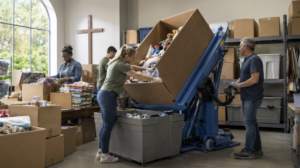
Churches are often known for worship services, fellowship, outreach, children’s ministries, food drives, seasonal events, and community support. Behind all of that ministry, however, there is another side of church life that does not always get the attention it deserves: the physical work that keeps everything moving.
Every week, churches receive supplies, move tables and chairs, sort donations, unload food pantry items, organize storage rooms, prepare seasonal decorations, handle maintenance materials, and manage equipment for events. Much of this work is done by staff members, volunteers, ministry leaders, and generous people who simply want to help. That is a blessing, but it can also create a hidden safety concern when heavy bins, large boxes, bulk containers, and stacked materials are handled by hand.
Church improvement is not only about better lighting, nicer seating, updated sound systems, or fresh paint. It is also about building safer systems that protect the people who serve. One overlooked piece of equipment that can make a major difference in the right church environment is a Gaylord Tilter. For churches that manage large donations, bulk storage, facility supplies, food pantry operations, thrift ministry items, or warehouse-style spaces, this type of equipment can help reduce unnecessary strain, improve organization, and support safer day-to-day operations. 🙌
Church Improvement Starts Behind the Scenes
Most people see the sanctuary, lobby, classrooms, fellowship hall, and parking lot. They notice whether the building feels welcoming, clean, accessible, and organized. What they may not see are the storage areas, supply rooms, donation spaces, maintenance closets, and volunteer work zones that make ministry possible.
A church may host Sunday services, weekday Bible studies, youth nights, funerals, weddings, community meals, school supply drives, clothing donations, food distribution, holiday outreach, and special events throughout the year. Each of those ministries requires physical preparation. Chairs are moved. Boxes are stacked. Supplies are sorted. Food is unloaded. Seasonal decorations are stored. Donation bins are emptied. Cleaning products, paper goods, and facility materials have to be kept in order.
That is why church improvement should include the practical areas of the building, not only the public-facing spaces. A church that improves its storage and material-handling process is really improving the experience for volunteers, staff, guests, and the community. Resources like Smart Church Solutions regularly emphasize the value of organized church facility management, preventative maintenance, and safe building walkthroughs as part of responsible stewardship.
When these behind-the-scenes areas are ignored, clutter grows, volunteers improvise, and people begin lifting or dumping materials in ways that can lead to injury. A safer facility is not only more efficient; it communicates care.
Why Storage and Donation Areas Can Become a Safety Risk
Church storage rooms have a way of filling up quickly. A few boxes of Vacation Bible School supplies become a wall of bins. A small food pantry becomes a weekly distribution center. A seasonal clothing drive turns into stacks of bags, totes, and bulk containers. A maintenance closet becomes the place where everything gets placed until someone has time to organize it.
The risk is not always obvious at first. A volunteer may bend over repeatedly to reach the bottom of a large box. Someone may try to tip a heavy container by hand. A staff member may lift awkwardly because the item is too wide or too low. Another volunteer may climb around stacked materials because the storage area has become too crowded. Over time, these small issues can become serious problems.
The Occupational Safety and Health Administration notes in its material-handling guidance that improper handling and storing of materials can result in costly injuries, and OSHA’s general storage standard says stored materials should not create hazards and should be stable and secure. Churches may not think of themselves as industrial workplaces, but the same common-sense safety principles apply when people are lifting, stacking, sorting, moving, and unloading materials.
This matters especially because churches often depend on volunteers. Volunteers may be older adults, teenagers, parents, ministry leaders, or community members who are not trained in warehouse-style handling. They want to help, but they should not have to risk back strain, shoulder injuries, falls, or crushed fingers to serve well.
Donation Ministries Need Better Systems, Not More Strain
Many churches are deeply involved in donation-based ministry. They collect food, clothing, school supplies, hygiene products, toys, household goods, diapers, cleaning supplies, and disaster relief items. These ministries are powerful because they meet real needs, but they can also create a lot of physical work.
Churches that run food pantries, thrift areas, benevolence closets, or community distribution events may receive bulk donations in large containers. Volunteers often have to sort items quickly, remove damaged products, divide goods into categories, and prepare them for distribution. The larger the outreach grows, the more important the system becomes.
Food banks and hunger relief organizations show how important organized volunteer workflows can be. For example, Feeding America highlights the role of food distribution networks in helping communities receive needed support. On a smaller local level, churches often serve as the place where that community care becomes personal.
However, when donation handling is disorganized, the ministry can become stressful. Volunteers may feel overwhelmed. Items may get damaged. Storage rooms may become unsafe. Leaders may spend more time managing clutter than serving people. Better equipment and better layout can help a church protect both the mission and the people carrying it out.
A tilter can be valuable in the right setting because it helps position large containers at a better angle for unloading, sorting, or emptying. Instead of having people reach deep into a large box or manually tip a heavy container, the equipment helps make the work more controlled and ergonomic.
Facility Work Is Ministry Work
It is easy to separate ministry from maintenance, but in a church, facility work supports ministry. Clean floors, clear exits, organized storage rooms, safe donation areas, reliable equipment, and accessible spaces all help the church serve better.
A well-managed church building can host more outreach, reduce stress on volunteers, and make events smoother. A poorly managed building can create confusion, safety hazards, and unnecessary expenses. Church improvement news often focuses on renovations, restorations, and expansions, but practical facility upgrades can be just as important.
The history of church architecture shows that church buildings have long been designed to support worship, gathering, teaching, and community life. Today, that same idea applies not only to sanctuaries and steeples but also to storage areas, fellowship halls, kitchens, loading zones, and ministry workrooms.
A church building is not just a structure. It is a tool for service. When that tool is cared for properly, the entire ministry benefits. When equipment is chosen carefully, staff and volunteers can spend less energy fighting the building and more energy serving people.
A Safer Church Is a Better Church for Volunteers
Volunteers are one of the greatest assets a church has. They greet guests, teach children, prepare meals, lead small groups, pack food boxes, organize events, clean after gatherings, decorate for holidays, and respond when there is a need. Protecting volunteers should be a major part of church improvement.
Safety does not have to feel cold or corporate. In a church setting, safety is an expression of love and stewardship. It says the people who serve are valuable. It says the church is paying attention. It says no ministry goal is worth avoidable injury.
Large bins and bulk boxes can be especially difficult for volunteers because they require awkward movements. Reaching down into deep containers places stress on the back and shoulders. Pulling items from the bottom of a box can cause strain. Tipping a container manually can create a sudden shift in weight. Trying to dump materials without proper support can cause slips, spills, or collisions.
Equipment that improves the angle, height, and control of these tasks can make the work safer and more manageable. That is why a church that handles bulk materials should look at its storage and donation process with the same seriousness it gives to child safety, parking lot safety, emergency exits, and building security.
Churches Are Becoming Community Hubs
Across the country, many churches are rethinking how their buildings serve the surrounding community. Some are renovating old spaces. Some are opening food ministries. Some are partnering with local organizations. Some are preserving historic properties while expanding outreach. The National Trust for Historic Preservation’s National Fund for Sacred Places highlights how houses of worship often function as important community centers that need thoughtful stewardship and preservation.
This trend matters because the more a church building is used, the more physical demands it carries. A church that serves only one weekly gathering has one kind of facility need. A church that hosts food distribution, counseling, classes, community meetings, youth events, recovery groups, and seasonal drives has a very different operational load.
Growth in outreach is a good thing, but it should be matched with better systems. As ministries expand, churches need to ask whether their current storage areas, loading practices, donation systems, and volunteer workflows are still safe. A growing ministry should not depend on unsafe shortcuts.
The Associated Press has covered restoration work at historic churches, including projects where old sacred spaces are being repaired and renewed for future generations. These stories show that church improvement can involve beauty, preservation, safety, and community purpose at the same time. Practical upgrades may not always make headlines, but they help churches stay ready for the work God has placed in front of them.
Better Equipment Can Reduce Clutter and Improve Workflow
A cluttered storage room is more than an eyesore. It slows down ministry. Volunteers cannot find what they need. Staff members waste time moving items twice. Donations get mixed together. Seasonal supplies get buried. Safety hazards become normal.
A better workflow starts with asking how materials move through the church. Where do donations arrive. Where are they sorted. Where are they stored. Where are they distributed. Where do empty boxes, bins, or bulk containers go after use. When this flow is not planned, people create temporary solutions that become permanent problems.
A tilter can support this workflow when the church regularly handles large bulk containers. It can help make unloading more controlled. It can reduce the need for repeated deep bending. It can help staff and volunteers access contents more easily. It can also support cleaner work zones because materials can be emptied or transferred with less mess.
Of course, equipment alone does not solve every problem. Churches still need clear storage policies, labeled areas, trained volunteers, scheduled cleanouts, and facility leadership. However, the right equipment can remove a major pain point from the process.
Stewardship Includes Protecting People and Resources
Church leaders often think about stewardship in terms of money, time, buildings, and ministry resources. Safety should be part of that same conversation. When a church invests in better systems, it is not wasting money. It is protecting people, preserving donations, reducing risk, and making ministry more sustainable.
The Church Law & Tax resource center regularly addresses practical church risk, administration, and legal issues, reminding church leaders that responsible management matters. Facility safety belongs in that category because one avoidable injury can affect a volunteer, a family, a ministry team, and the church’s ability to serve.
Good stewardship also means using donated items wisely. If supplies are damaged because they are stacked poorly, stored carelessly, or handled roughly, the church loses value. If volunteers burn out because the work is physically exhausting, the ministry loses capacity. If staff members spend hours fixing preventable storage problems, the church loses time.
A safer, more organized system helps the church honor both the giver and the receiver. It helps donations move from storage to service with less waste and more care.
When a Church Should Consider Material-Handling Equipment
Not every church needs industrial-style equipment. A small congregation with limited storage may only need better shelves, labels, carts, and volunteer training. However, churches with larger operations should take a closer look.
A church may benefit from better material-handling equipment if it receives bulk donations, manages a food pantry, stores supplies in large containers, operates a thrift ministry, handles maintenance materials, runs frequent community events, or depends on volunteers to unload and sort heavy items. It may also be useful for churches with school programs, camp supplies, disaster relief collections, or large seasonal outreaches.
Warning signs include volunteers manually tipping large boxes, people reaching deep into containers, frequent back strain complaints, crowded storage areas, unstable stacks, damaged goods, or donation days that feel chaotic. These signs do not mean the ministry is failing. They mean the ministry has grown beyond its current system.
Church improvement should be proactive, not only reactive. Waiting until someone is hurt is the wrong way to discover that the process needs improvement. A thoughtful review of storage, donations, and facility work can help leaders make wise decisions before problems become emergencies.
Conclusion
The most overlooked church improvements are often the ones that happen behind the scenes. A cleaner storage room, a safer donation area, a better unloading process, and the right equipment can make a meaningful difference in how a church serves.
A church is more than a building, but the building still matters. It houses worship, outreach, fellowship, teaching, compassion, and community care. When churches improve the practical systems inside that building, they protect the people who make ministry possible.
For churches that handle large containers, bulk donations, heavy supplies, or repeated sorting work, a tilter may be one of the most practical upgrades they have never considered. It can help reduce strain, support safer workflows, protect volunteers, and make facility work more efficient.
Church improvement is not only about what looks beautiful on Sunday morning. It is also about what keeps people safe on Monday, Tuesday, Wednesday, Thursday, Friday, and Saturday. When churches care for their storage spaces, donation ministries, and facility teams, they are caring for the mission itself. 🙏