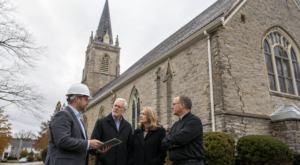
Church buildings are more than walls, roofs, and foundations. They are places where families gather, children learn, communities find help, and generations build memories together. In New Jersey, many churches have been standing for decades. Some have beautiful masonry, tall bell towers, large sanctuaries, balconies, fellowship halls, classrooms, and additions that were built at different times.
That history gives a church character, but it can also hide structural problems that slowly develop over the years.
A small crack in a sanctuary wall may be easy to ignore. A floor that feels slightly uneven may become something everyone simply gets used to. Water stains near a roof beam may get painted over before the next Christmas service. Unfortunately, buildings do not stop aging because a congregation is busy.
The difference between a manageable structural repair and a serious building emergency often comes down to timing. ⛪
Older New Jersey Church Buildings Have Unique Structural Challenges
New Jersey has a long history of established towns and communities, and many local churches occupy buildings that were constructed under very different building practices than those used today. The broader history and development of New Jersey helps explain why communities throughout the state contain such a wide variety of older institutional and religious structures.
A church may have started as a small brick sanctuary and later gained a fellowship hall. A classroom wing may have been added twenty years after that. Another renovation may have opened a wall, moved a staircase, installed new mechanical equipment, or changed the use of an entire floor.
Each individual project may have seemed reasonable at the time. The concern is how all of those changes affect the building as a complete structure.
Structural systems work together. Roof framing transfers weight to walls and columns. Walls and columns transfer loads toward the foundation. Foundations distribute those loads into the ground. When one part of that system changes, settles, deteriorates, or becomes overloaded, the effects can begin appearing somewhere else.
This is one reason church leaders should not assume that every crack is simply cosmetic or every sloping floor is just part of an old building’s charm.
Structural Problems Rarely Announce Themselves All at Once
Major building problems can seem sudden when they finally become visible to the public. In reality, structural deterioration may develop over a much longer period.
New cracks may begin appearing around doors and windows. Masonry joints may deteriorate. A basement wall may start bowing inward. Steel components may show corrosion after repeated moisture exposure. Roof framing may begin sagging. Wooden members can experience deterioration where water has been entering unnoticed.
The Associated Press reported on a fatal balcony collapse in Sea Isle City, New Jersey, where the building was evacuated and balconies were stabilized for engineering evaluation. The incident involved a condominium rather than a church, but it is a serious reminder that structural conditions deserve professional attention when warning signs appear.
Churches often have another challenge. Many people use the building, but no single person sees every part of it.
The pastor notices a ceiling crack in the office. The maintenance volunteer knows about water in the basement. A Sunday school teacher realizes one classroom door has become difficult to close. The worship team notices vibration near a platform. The trustee board knows the roof leaked two winters ago.
Individually, those details may seem unrelated. A structural engineer can look at the entire building and determine whether there is a larger pattern.
A Structural Engineer Looks Beyond What Can Be Seen on the Surface
A contractor may be excellent at repairing masonry, replacing roofing, installing beams, or renovating interiors. A structural engineer has a different responsibility.
The engineer evaluates how the structure is performing.
For a New Jersey church concerned about cracking, settlement, framing, columns, foundations, or other structural conditions, working with a Structural Engineer New Jersey professional can provide a technical evaluation of the building and help church leaders understand the significance of visible concerns.
The goal is not to create panic every time someone finds a crack.
The goal is to separate minor conditions from problems that require further attention.
A structural engineer may evaluate the location and pattern of cracks, visible deflection, foundation conditions, framing systems, load paths, movement, deterioration, previous modifications, and other factors connected to the structure.
That distinction matters because simply repairing the visible symptom may not correct the underlying cause.
Patching a crack does not stop movement if the building is continuing to settle. Replacing ceiling material does not repair damaged roof framing. Painting a water stain does not remove the source of long-term moisture exposure.
Churches should know what they are repairing before they begin spending money on the repair.
New Jersey Is Paying Greater Attention to Structural Integrity
Structural safety has become a significant public issue far beyond church properties. In January 2024, New Jersey enacted additional structural integrity procedures for certain condominium and cooperative residential buildings. The law does not automatically apply those residential inspection requirements to churches, but the state’s action reflects a broader recognition of the importance of identifying structural concerns and maintaining building integrity. The State of New Jersey’s official announcement specifically described the new procedures as focused on inspecting, evaluating, and maintaining structural integrity.
Church boards should pay attention to the larger conversation surrounding aging buildings.
Local issues involving construction, infrastructure, property conditions, and community safety regularly become part of NJ Spotlight News coverage and other statewide reporting. NJ Spotlight News has covered New Jersey infrastructure and building-related investment issues over the years.
The lesson for a church is simple. A building should not have to become a local news story before its condition receives serious attention.
Historic Churches Can Face Expensive Consequences When Problems Progress
One of the most sobering New Jersey church examples is the former Church of the Ascension in Atlantic City.
According to the documented Church of the Ascension history, the church was closed after an engineering firm determined the building was structurally unsound and that the bell tower presented a danger to the community. The building was eventually demolished.
Every church building and structural condition is different, and that example should not be used to assume that a cracked wall means a church is facing demolition.
It does show what is at stake.
Church buildings often include specialized architectural features that can be costly and difficult to replace. Bell towers, steeples, large-span sanctuary roofs, historic masonry, decorative stone, balconies, and unique framing systems are not always simple construction projects.
Waiting can reduce a church’s options.
A problem caught earlier may allow leaders to discuss targeted repairs, monitoring, stabilization, or a planned construction project. A problem discovered after significant deterioration may require emergency action and a much larger financial commitment.
For a church operating through donations, budgets, and carefully managed funds, that difference can be enormous.
Renovations and Church Growth Can Change Structural Demands
Growth is exciting for a church. A growing congregation may need more classrooms, a larger worship space, a new stage, additional offices, or a redesigned fellowship hall.
Those plans can also affect the structure.
Removing walls to create an open gathering area may involve load-bearing components. Installing large audiovisual systems can introduce additional weight. New mechanical equipment may place loads on roof systems. Sanctuary renovations can affect balconies, platforms, and framing. Repurposing an older part of the building can place different demands on floors and structural components.
Church leaders following community development through outlets such as the New Jersey Monitor know how quickly local issues involving development, government, and community needs can change throughout the state. The New Jersey Monitor describes its work as reporting on issues affecting New Jersey communities, including education and social issues.
Churches change with their communities as well.
A building designed for one use decades ago may now be expected to support a very different ministry.
A structural engineer can help evaluate proposed modifications before construction begins. That can give the architect, contractor, and church leadership clearer information about structural requirements and potential limitations.
Discovering a major structural issue after demolition has already started is rarely the best way to begin a church renovation.
Water Is One of the Most Easily Ignored Building Problems
New Jersey churches experience rain, snow, freezing temperatures, humidity, and seasonal temperature changes. Water intrusion can become especially damaging when it continues year after year.
A roof leak may initially appear to be a roofing problem. In many cases, fixing the roof is exactly what is needed. The concern is what happened before the leak was repaired.
Repeated moisture exposure can contribute to deterioration of wood framing, corrosion of metal components, damage around masonry, and other building problems. Water around foundations can also be connected to drainage or soil conditions that deserve evaluation.
The statewide and local stories collected by Patch’s Across New Jersey news coverage demonstrate how varied community conditions and property-related events can be across New Jersey’s towns. Patch maintains dedicated local and statewide New Jersey news coverage.
A church in Bergen County may have a different building history and site conditions than a church near the Jersey Shore. A congregation in an older urban neighborhood may be maintaining a masonry structure surrounded by development, while another church may sit on a large suburban property with drainage and soil concerns.
There is no single inspection checklist that makes every church building the same.
The building has to be evaluated based on its actual construction and condition.
Church Leaders Need Clear Information Before Approving Major Repairs
Church boards carry a difficult responsibility.
They are often making decisions involving money donated by people who trust church leadership to use it wisely. When a large building repair is proposed, leaders may receive different opinions from contractors, volunteers, maintenance companies, and congregation members.
Everyone may be sincerely trying to help.
That does not make every opinion a structural conclusion.
A structural engineering evaluation can give church leaders technical information that helps them ask better questions and make more informed decisions.
The engineer’s findings may help define the structural concern, identify areas requiring further investigation, and provide repair recommendations or engineering documents when appropriate.
This information can also help when church leadership begins communicating with contractors.
Instead of asking a contractor to simply “fix the crack,” the church may have a better understanding of why the crack developed and what type of corrective work should be considered.
Clear information can reduce guesswork.
A Church Should Not Wait for a Structural Concern to Become an Emergency
There is a tendency to delay building investigations because everyone fears the same thing.
The cost.
Church leaders may worry that bringing in an engineer will uncover an expensive problem. The problem with that reasoning is that the building’s condition already exists whether an engineer sees it or not.
Ignoring the condition does not make the building stronger.
News organizations and community resources throughout the state continue to document issues that matter to New Jersey residents. The official State of New Jersey website also provides state news and information from New Jersey departments and agencies.
Churches should develop the same habit of paying attention to their own properties.
New cracks, visible movement, significant floor slopes, sagging structural components, bowing walls, foundation concerns, deteriorating masonry, damaged framing, and structural changes associated with renovations should not simply become part of the scenery.
Someone needs to take a closer look.
Protecting the Building Helps Protect the Ministry
A church building serves a purpose far greater than the structure itself.
It gives people a place to worship. It provides classrooms for children. It may host food programs, counseling, community meetings, youth events, funerals, weddings, and outreach programs.
When a serious building problem forces part of a church to close, the impact extends beyond a construction budget.
Ministry can be interrupted.
This is why structural evaluations should not always be viewed as an unnecessary expense or something reserved for buildings that are already in obvious distress.
They are part of responsible property stewardship.
A structural engineer can help church leaders understand the building they have, the concerns that may be developing, and the structural issues that should be addressed before they become more complicated.
Conclusion
Every New Jersey church has a story, and many church buildings carry decades of that history in their walls, foundations, sanctuaries, and steeples.
Age alone does not mean a church building is unsafe. A small crack does not automatically mean a structural disaster is developing. At the same time, church leaders should not rely on assumptions when visible conditions begin changing.
Structural problems are far easier to discuss when the sanctuary is open, the congregation is safe, and leadership still has time to plan.
The worst time to start searching for answers is after a building condition has become an emergency.
For New Jersey churches, recognizing warning signs and obtaining qualified structural guidance can help protect the building, preserve church resources, and allow the congregation to remain focused on the ministry taking place inside those walls.
Sometimes the most responsible repair decision begins before anyone picks up a hammer.