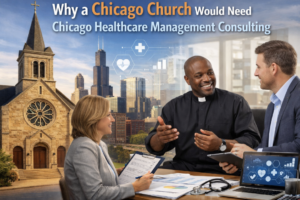
Chicago churches do far more than hold Sunday services. They host food pantries, recovery groups, youth programs, grief support, immigrant assistance, and community gatherings that function like the city’s living room. In neighborhoods where a clinic is far away, where trust in institutions is complicated, and where everyday life comes with real stress, the church often becomes the place people bring their whole selves, including health needs, mental health struggles, and family crises.
That is exactly why Chicago Healthcare Management Consulting matters for a Chicago church. Not because the church is turning into a hospital, but because modern ministry in a major city touches healthcare realities every day. Consulting brings structure, compliance, strategy, and sustainable systems so the church can care well, protect its people, and stay focused on its mission.
Healthcare Ministry Is Already Happening, Even When It Isn’t Called “Healthcare”
Many Chicago churches are already operating in the healthcare space without labeling it that way. Counseling referrals, addiction support, homebound visits, caregiver support, meal trains after surgeries, rides to appointments, mental health workshops, and partnerships with nonprofits all sit on the same spectrum of care. When churches expand into hosting screenings, vaccines, nurse visits, or health education events, the stakes rise quickly.
Chicago is also a city where faith leaders regularly engage public systems and urgent social needs. Faith-related news here intersects with health, safety, and community wellbeing, from neighborhood environmental concerns to the pressures facing vulnerable populations. Coverage like the National Catholic Reporter’s reporting on Chicago Christian leaders advocating around lead pipes shows how deeply “health” and “church” overlap in this region’s public life (National Catholic Reporter – EarthBeat).
A healthcare management consultant helps a church name what it is already doing, define the scope, reduce risk, and build a plan that matches the church’s capacity.
Compliance and Risk Management Protect the Mission
When a church coordinates anything that resembles health services, even indirectly, it can accidentally step into regulated territory. Privacy expectations, record handling, mandated reporting, safety protocols, volunteer screening, youth protections, facility standards, incident documentation, and referral boundaries all matter. A consultant helps the church formalize policies so ministry remains ministry and does not become an unintentional liability.
This is especially relevant in Chicago, where churches are not operating in a quiet bubble. Faith institutions are covered in local media for governance decisions, accountability issues, and institutional actions, which can increase scrutiny and reputational risk. WBEZ’s reporting on Archdiocese decisions is one example of how quickly church operations become public-facing and high-stakes (WBEZ Religion).
Consulting support helps leadership create clear guardrails, training, and documentation practices that protect congregants, volunteers, staff, and the church’s long-term credibility.
Mental Health Needs in Chicago Are Too Big for Informal Systems
Chicago churches are often the first place people disclose anxiety, depression, trauma, domestic crises, or substance struggles. The need is real, and the margin for error is real too. A church can be compassionate and still need a professional system for triage, referral pathways, crisis escalation, and boundaries for lay leaders.
This is not hypothetical. Chicago media has covered coordinated church efforts aimed at mental health support, including large-scale participation by Black churches addressing mental health services and counseling resources (Chicago Sun-Times).
Healthcare management consulting can help a church build a responsible mental health ministry model that includes:
-
Vetted referral networks to licensed clinicians and community providers
-
Clear “when to call 988, when to call 911” escalation protocols
-
Volunteer training and role definitions so helpers do not become pseudo-therapists
-
Partnerships with local organizations that can provide clinical services legally and ethically
-
Documentation standards that are sensitive, minimal, and protective
The result is safer care, stronger leadership confidence, and fewer burnout cycles among the people who always end up carrying the emotional load.
Partnerships with Clinics, Hospitals, and Nonprofits Need Operational Structure
Chicago churches often partner with health systems, community clinics, street outreach groups, and social service organizations. These partnerships can be powerful, and they can also become messy if they are built on goodwill alone. Scheduling, facilities use, insurance coverage, responsibilities, intake flows, signage, crowd management, emergency planning, and communication with congregants all need clarity.
A consultant can step in to create a partnership blueprint: MOUs, workflows, operational checklists, and accountability dashboards. That structure protects the relationship and increases the likelihood the partnership survives leadership changes, funding shifts, and volunteer turnover.
Chicago faith leaders also navigate complex public issues that involve health and safety, including immigration enforcement and community tension points. When churches serve as stabilizers in these moments, it helps to have operations that do not break under pressure. WTTW’s reporting on Chicago religious leaders responding to immigration enforcement pressure shows how quickly conditions can change around a ministry environment (WTTW News).
Operational structure is not bureaucracy for its own sake. It is what makes compassion scalable.
Church Staff and Clergy Health Systems Are Real Healthcare Management Too
A Chicago church is also an employer. That means health benefits decisions, HR compliance, disability accommodations, leave policies, wellness initiatives, and often complicated insurance questions. For churches with schools, multiple campuses, or large staff teams, benefits management can become a major expense and a major stress point.
Healthcare management consulting can help evaluate benefit offerings, manage vendor relationships, improve employee experience, and reduce waste without harming care. It can also support clergy wellness planning, retirement-related healthcare planning, and sustainable staffing models so the church does not lose its leaders to preventable burnout.
In Chicago, the institutional church ecosystem is large and organized, with internal ministries and services that touch healthcare realities. Resources hosted through the Archdiocese show how health-focused initiatives and communications already function as part of the local church environment (Archdiocese of Chicago – News Releases). Consulting can help local churches align with trusted resources while tailoring implementation to their specific congregation and neighborhood.
Stewardship Requires Financial Clarity When Care Gets Complex
Chicago churches are trying to steward donations faithfully while meeting growing community needs. When a church adds any health-related programming, costs can multiply quickly: training, background checks, facility upgrades, security, supplies, technology, insurance, translation, transportation support, and partnership expenses.
A healthcare management consultant helps leadership treat health-adjacent ministry like a program with measurable inputs and outcomes. That includes budgeting models, grant readiness, program KPIs, and governance structure. It also includes deciding what the church should not do, which is often the most responsible move a church can make.
This is where churches win back time and peace. Instead of reacting to needs one emergency at a time, consulting builds a plan that keeps the church proactive and financially steady.
Technology, Data, and Communication Matter More Than Ever
Churches today communicate like small media companies. They manage member databases, prayer requests, benevolence needs, volunteer rosters, and sometimes sensitive pastoral care notes. When health and crisis issues are involved, the way information is stored and shared matters. Even when a church is not legally bound by healthcare privacy laws in the same way a hospital is, the ethical expectation of confidentiality is high, and the reputational risk is high.
A consultant helps tighten systems: role-based access, secure tools, minimal data collection, retention policies, incident response plans, and training that reduces accidental disclosure. This protects the dignity of congregants and protects the church’s leadership from unforced errors.
The Chicago Context Makes This Even More Important
Chicago is not a small town where informal systems can limp along forever. The city’s scale, diversity, public health challenges, and neighborhood-level disparities mean that churches often serve people with complex needs. Churches also sit in the middle of civic life, and “church news” frequently overlaps with community health realities, policy debates, and high-visibility events.
The very existence of the Archdiocese of Chicago as a major institution reflects how deeply embedded church life is in the city’s fabric (Wikipedia – Archdiocese of Chicago). In that environment, local congregations benefit from professional guidance that helps them serve responsibly, sustainably, and in ways that keep trust intact.
Conclusion
A Chicago church needs Chicago Healthcare Management Consulting for the same reason it needs strong preaching, strong governance, and strong community relationships: because the mission is too important to run on improvised systems.
Healthcare management consulting helps a church build safer mental health supports, manage partnerships responsibly, protect privacy, reduce risk, strengthen staff benefits decisions, and create sustainable plans for care ministries that truly fit the church’s capacity. In a city as complex and intense as Chicago, that kind of structure is not a luxury. It is how a church stays steady, stays credible, and keeps showing up for the people who depend on it.